

Flat bottomed so she could sit on the mud at low water, rigged so two people could work her, and shaped entirely by a river that empties twice a day. A short profile of the Thames spritsail barge, and one frame you cannot get from the bank.
The spritsail barge is the vessel the Thames was built around, and it is the clearest example anywhere of a design shaped entirely by its river.
She is flat bottomed, because a tidal river empties twice a day and a barge that cannot sit upright on the mud is a barge that breaks. She carries leeboards instead of a keel for the same reason. The sprit rig, with its enormous spar running diagonally across the mainsail, exists so that the sails can be brailed up against the mast in seconds without anyone going aloft, which is what lets a crew of two handle several hundred tons of hull in a crowded river. Every feature is an answer to a specific problem the Thames poses.
Almost all of them are gone. The ones still sailing are kept going by charter work, by trusts, and by people who care about them more than is financially sensible.
Why this particular frame is worth the effort
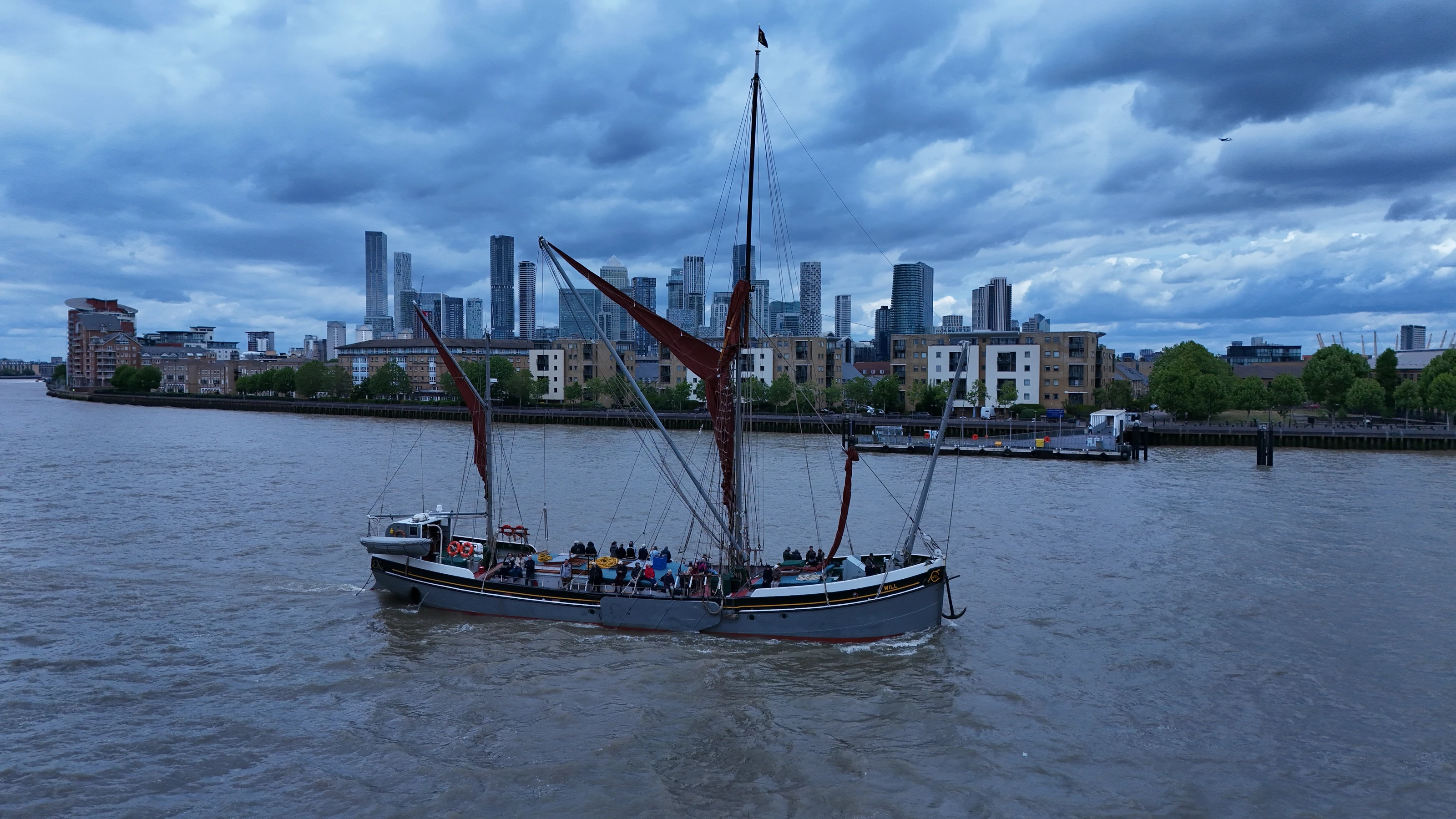
Will was on the river on 16 May 2026 with passengers on deck. The photograph that matters puts her in front of Canary Wharf.
That contrast is the entire point. A hull designed for the Victorian coasting trade, in front of a skyline built on the docks that trade served, on the same water that carried both. It is a hundred and fifty years of the same river in one frame.
You cannot stage it, and you cannot take it from the bank. From ground level the towers and the barge never line up: either the barge is small against a distant skyline, or you are close enough to the barge that the towers have gone behind her. It needs height, and it needs the vessel to be in a particular part of the reach at a particular state of tide, which means knowing in advance where she is going to be.
Flat light, honestly
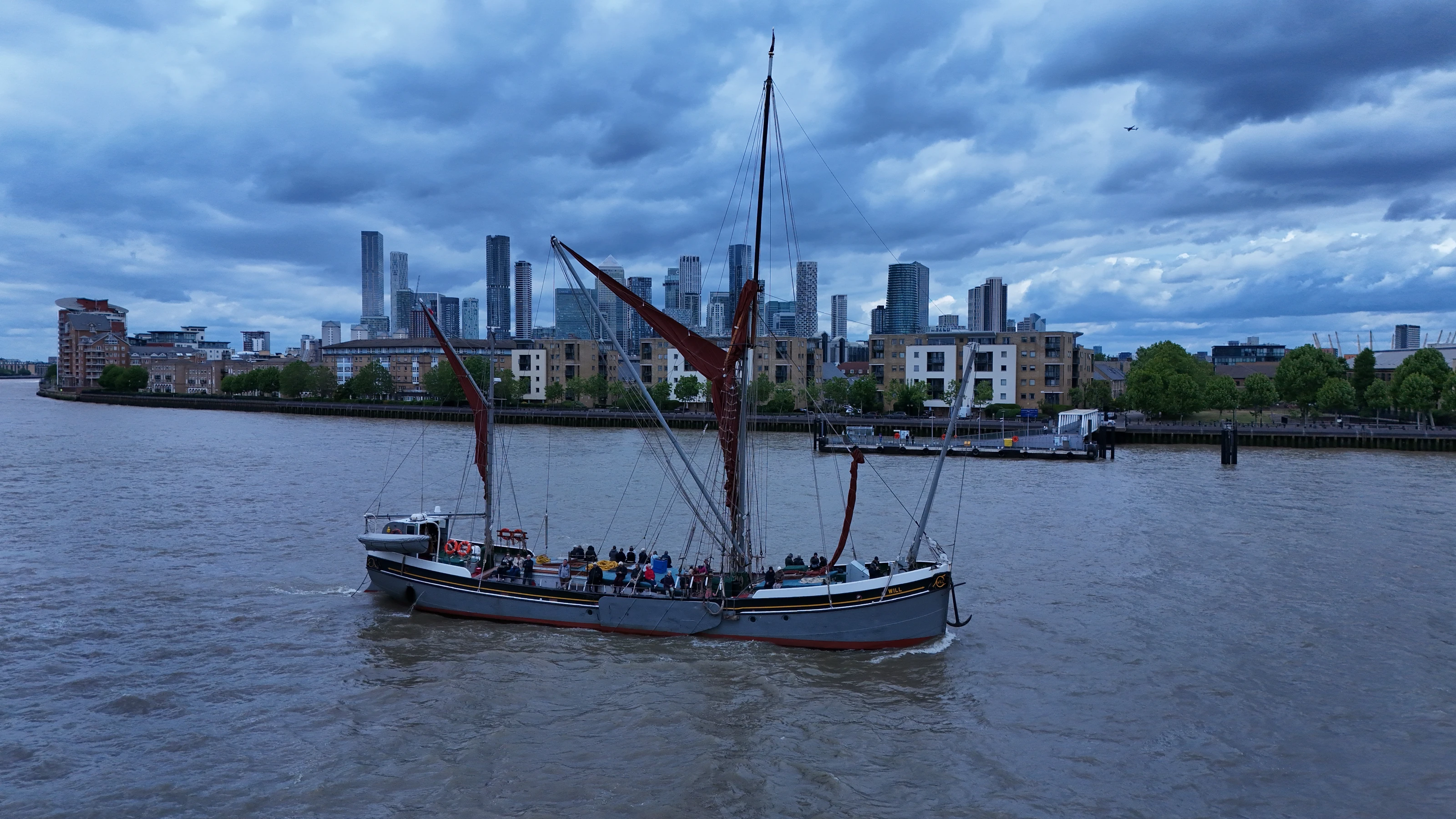
The light that day was flat. This is not golden hour work and there is no point pretending otherwise.
What carries the frame instead is colour and shape: the tan of the brailed sails against grey water, the black hull, the geometry of the sprit and the mast. Heritage vessels are unusually forgiving in dull light because their materials are inherently high contrast, tanned canvas, tarred hull, varnished brightwork. A modern white GRP vessel in the same conditions would look like nothing at all.
The useful lesson for anyone commissioning heritage coverage is that the weather is worth waiting for on a wide landscape frame and worth ignoring on a vessel like this. If the barge is sailing, go.
Photographing heritage vessels without spoiling them
Sailing barges are worked by hand, often by volunteer or small professional crews, in a busy tideway, under sail, in an unpowered vessel with limited ability to get out of anybody's way. That is the entire risk assessment in one sentence.
We stay well off, use focal length rather than proximity, and never put an aircraft where its noise would reach a crew who are listening to each other and to the rig. It is also basic courtesy: these vessels exist because people give up their weekends to them.
The set is on the Sailing Barge Will project page. Our other heritage work on the river includes the last tow of HMS President 1918 and the Thames Historic Barge Driving Race.
If you are involved with a heritage vessel, a trust or a river event and want it properly recorded from the air, see our Thames drone services or get in touch.