
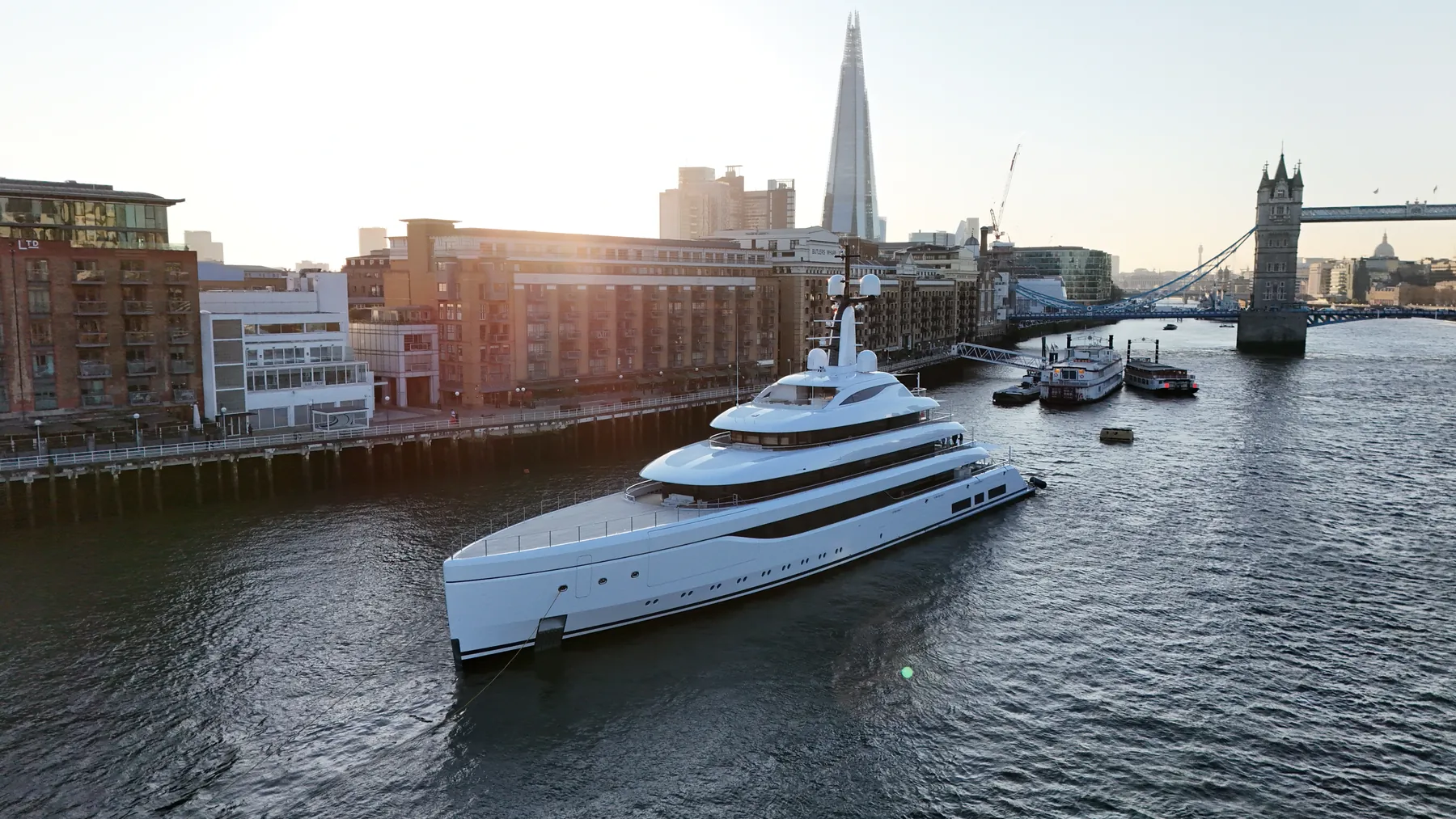
A superyacht in the Pool of London is a rare and short-lived subject, and the hardest part is not the yacht. It is everything around her: the most restricted airspace in the country, a working river, and a berth surrounded by several thousand tourists.
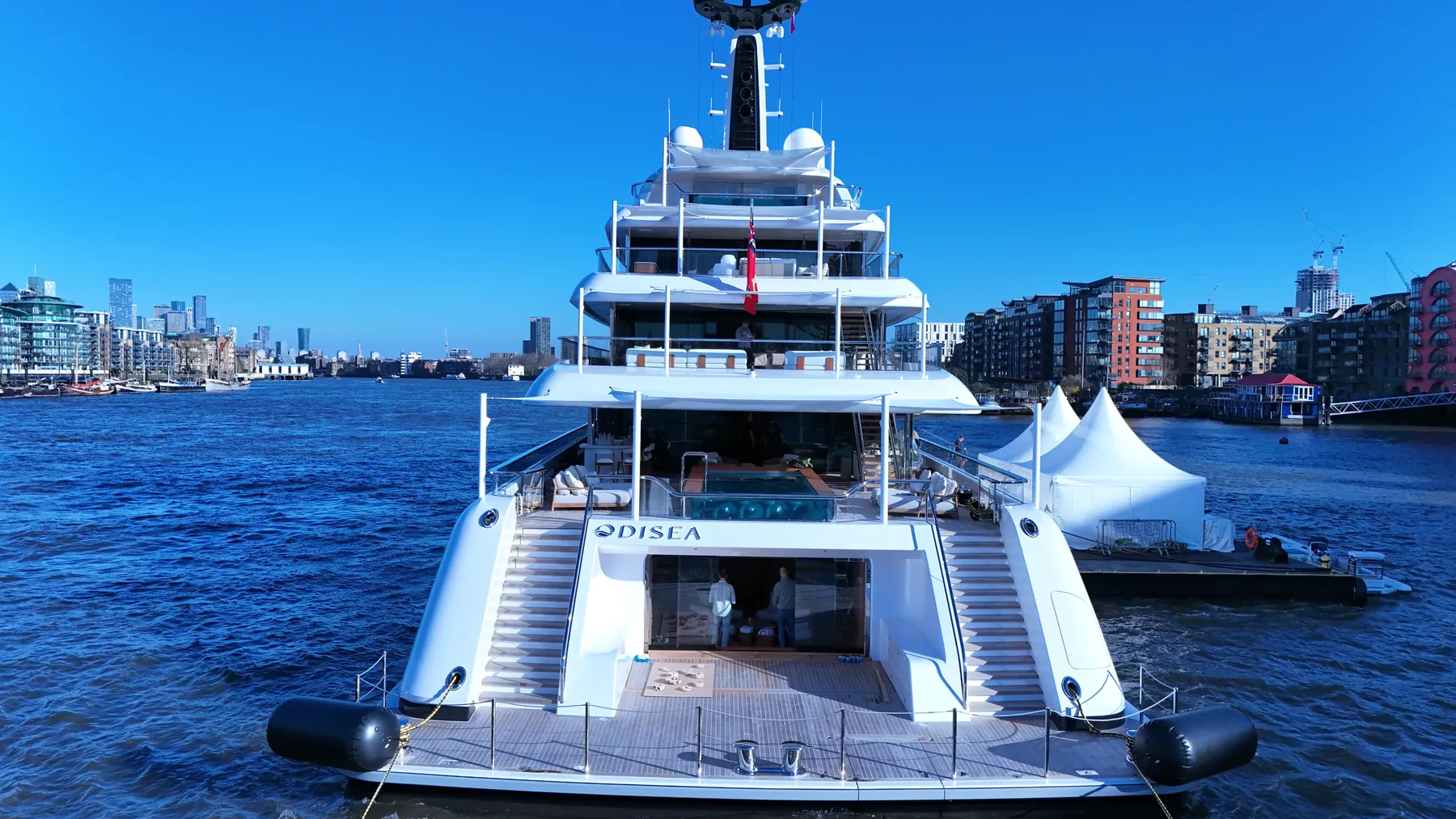
Odisea is 78.2 metres of Lürssen, delivered in March 2026, designed by RWD, and known during construction as Project Ace 21. She is owned privately, and the owner's interests were represented by Dan Robsham of MTS. In the spring of 2026 she was lying at Tower Bridge, in the middle of London, which is the sort of thing that happens perhaps a handful of times a year.
The yacht is the easy part
A new Lürssen is an extraordinarily photogenic object. The lines are clean, the paint is perfect, the deck layout is designed to be looked at, and at that length the vessel reads at any distance. Left alone in open water, it would be difficult to take a bad picture of her.
The difficulty in London is entirely contextual.
The airspace. Central London sits under some of the most restricted airspace in the United Kingdom, and Tower Bridge is close to its heart. Flying there commercially is not a matter of turning up; it is a matter of holding the right operational authorisations, planning the flight properly and coordinating it in advance. Our guide to drone filming in London's restricted airspace sets out how that works.
The people. Tower Bridge has crowds on it and around it at almost every hour. The rules about distance from uninvolved people are the binding constraint on where an aircraft may be, and they do not bend for a good photograph. In practice this means the flight is planned around where the aircraft can legally and safely be, and the composition is then built from those positions rather than the other way round.
The river. It is a working waterway. Clippers, trip boats, tugs and tows are all moving through the same reach on a tide, and the yacht is on a berth in the middle of it.
Time of day does most of the work
A moored vessel is a static subject, which sounds easy and is actually a trap. Nothing changes except the light, so the light has to carry every frame, and that means shooting the same subject across several conditions rather than in one visit.
Hard daylight gives you the paint, the detail and the scale against the bridge. Golden hour gives warmth across the topsides and long shadows on the deck. Blue hour, after sunset, is when a yacht like this comes into her own: the deck and interior lighting comes up, the hull goes dark, the bridge is floodlit and the whole composition turns into something a daytime frame cannot approach.
For an owner, a broker or a build team, that spread is the deliverable. One condition is a snapshot. Four conditions is a set.
Discretion is a deliverable too
Superyacht work carries expectations that other marine photography does not. Owners are private, crews are protective, and a great deal of what happens on deck is nobody's business.
That shapes the flying. Standoff distances, no frames into interiors or over occupied deck space, no publication of anything identifying guests or movements, and delivery arrangements agreed in advance. In practice it is the same discipline we apply to residential survey work, where frames that look into windows are discarded rather than delivered.
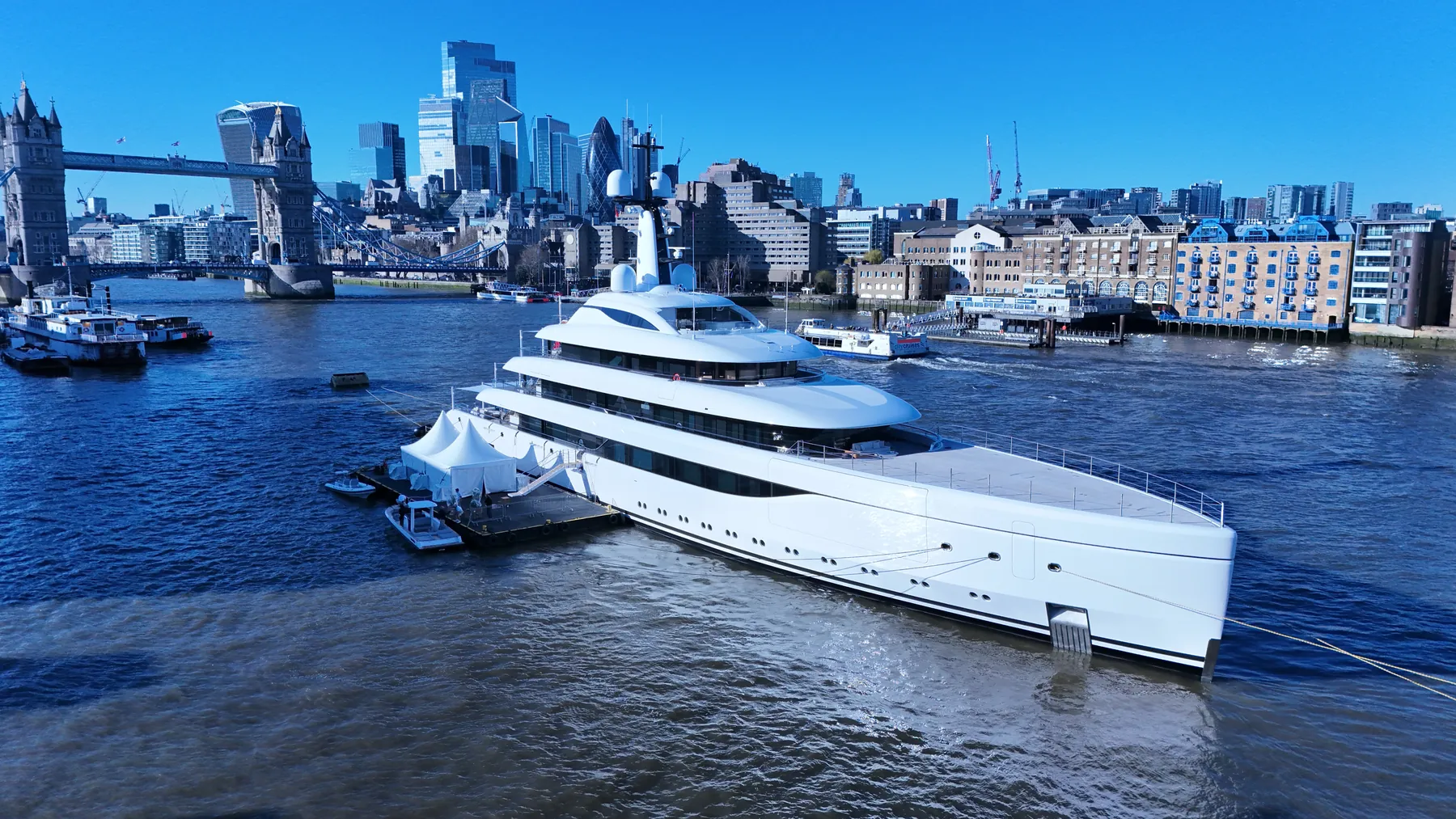
The full gallery is on the Odisea project page.
If you are a yard, a broker, a management company or an owner's representative with a vessel visiting London, the practical constraint is the window: these berths are short and the permissions take planning. Talk to us early. See our maritime drone services or get in touch.