
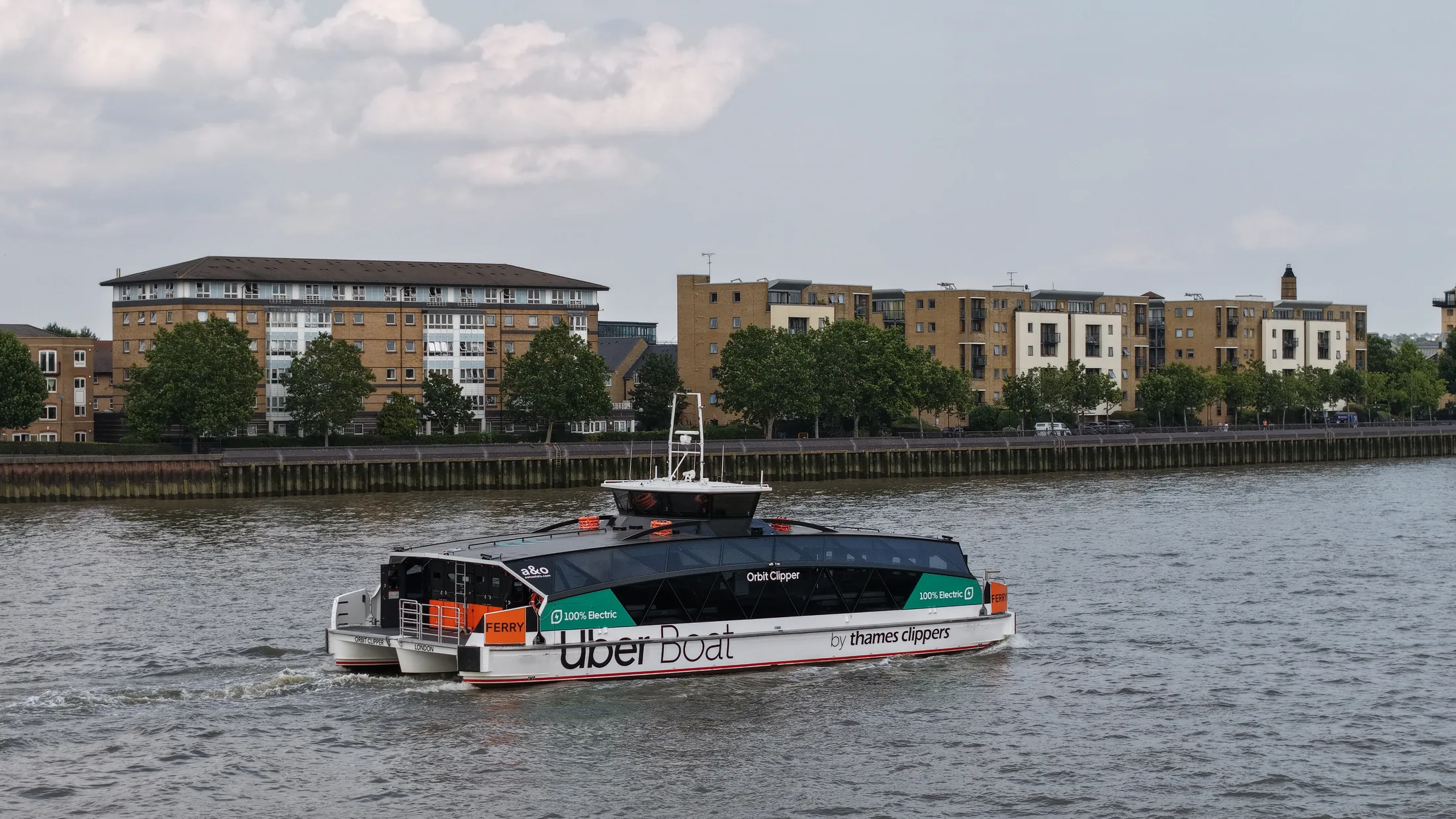
Orbit Clipper is the UK's first fully electric, zero-emission cross-river passenger ferry, running between Rotherhithe and Canary Wharf with room for 150 passengers and 100 bicycles. A vessel profile, and why the bikes are the whole point.
Between Tower Bridge and the Greenwich foot tunnel, the Thames is a wall. If you are on a bicycle at Rotherhithe and you want to be at Canary Wharf (a few hundred metres away as the gull flies), your options have historically been a long detour or a tube with a bike ban.
Orbit Clipper exists to close that gap. Operated by Uber Boat by Thames Clippers, she is described by the operator as the UK's first fully electric, zero-emission cross-river passenger ferry, running between Rotherhithe on the south bank and Canary Wharf on the north.
The bicycles are the whole design
The specification that matters most is the one that sounds least glamorous: 150 passengers and 100 bicycles.
A conventional river bus is designed around seated passengers carrying luggage at most. A vessel taking 100 bicycles is a different animal. It needs a large, flat, unobstructed deck, wide openings at each end, and a loading arrangement that lets people ride or wheel straight on and straight off without turning round. That roll-on/roll-off layout is what turns a boat trip into a piece of cycling infrastructure, and it drives the hull form too, pushing the design towards a broad, shallow catamaran platform rather than the fine-lined fast monohull you would choose for a long run downriver.
The route also happens to suit batteries about as well as any route could. Short, repetitive, high-frequency crossings mean the vessel is never far from a charge point, the duty cycle is predictable, and the energy needed per crossing is modest next to a fast passenger run down to Woolwich. The operator reports crossings every 10 minutes on weekdays and every 15 minutes at weekends, a cadence that only works if charging is quick enough to disappear into the turnaround. That infrastructure comes from Aqua superPower, who specialise in electric marine charging.
She was built by Wight Shipyard Company, with maritime civil engineering consultants Beckett Rankine among the project partners, and Uber Boat by Thames Clippers has reported funding support from the Department for Transport and Innovate UK. Her first passenger trip was on 5 December 2025, with the operator targeting full service during 2026. Widely reported dimensions put her at around 25.2 metres long and 10.1 metres in the beam, though those figures come from trade press rather than the operator's own launch material, so treat them as reported rather than official.
Why one small ferry is worth paying attention to
The Thames carries a great many passengers and almost no vehicles. Every crossing between central London and Woolwich is a bridge, a tunnel or nothing, and the two tunnels that take bicycles are Victorian, narrow and shut at night.
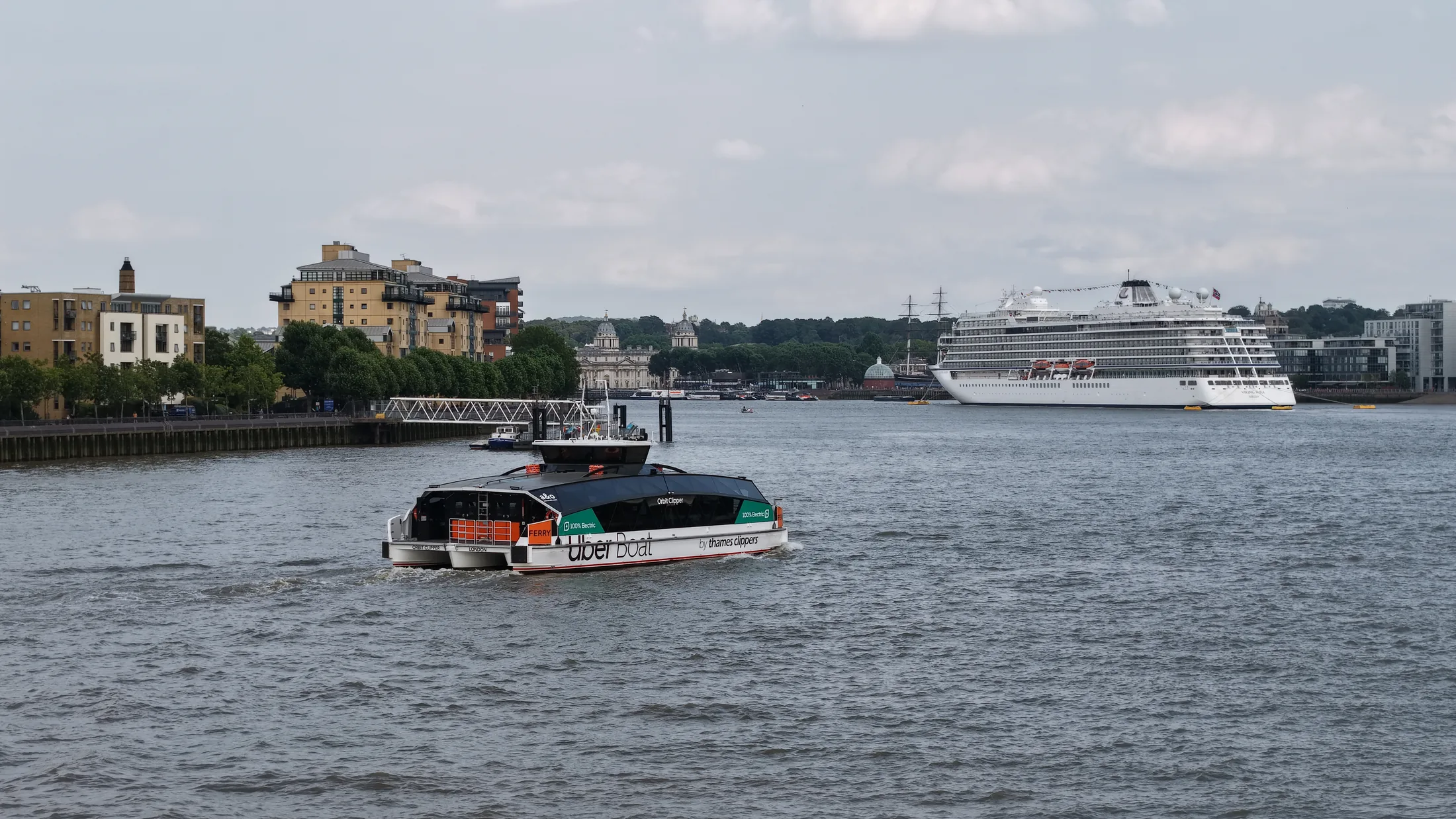
A fully electric ro-ro ferry tests whether short river crossings can be treated as ordinary transport links rather than tourist attractions. If the model works at Rotherhithe, the same argument applies at a dozen other points where the river is 250 metres wide and the road detour is five kilometres. It is also a proving ground for river electrification in general: the tideway is a demanding place to operate, with strong tides, heavy traffic and a great deal of debris, and a vessel that runs reliably on batteries here is a decent argument for the technology anywhere.
For current timetables, fares and pier information, see Uber Boat by Thames Clippers.
We had no involvement in the design, construction, launch, operation or promotion of Orbit Clipper. These photographs were made independently from the air over the Thames in July 2026, as part of our ongoing record of vessels working the tideway. She was photographed on the river in east London, and we have not represented the images as showing a scheduled service crossing.
Filming vessels on the tideway
Photographing a working ferry means fitting around a timetable rather than the other way round, and on the Thames it means planning around commercial traffic, bridge clearances and central London airspace.
We do this as Thames drone filming and boat filming in London, and our river background means we plan around a vessel's operation rather than interrupting it. See also our Thames drone services hub, our maritime drone services, and our aerial record of the 2026 Thames Historic Barge Driving Race.