
Logistics is an industry that moves enormous objects across long distances and then markets itself with a photograph of a lorry in a car park. Aerial coverage is the one medium that shows scale and reach, and there are three shots that do most of the work.
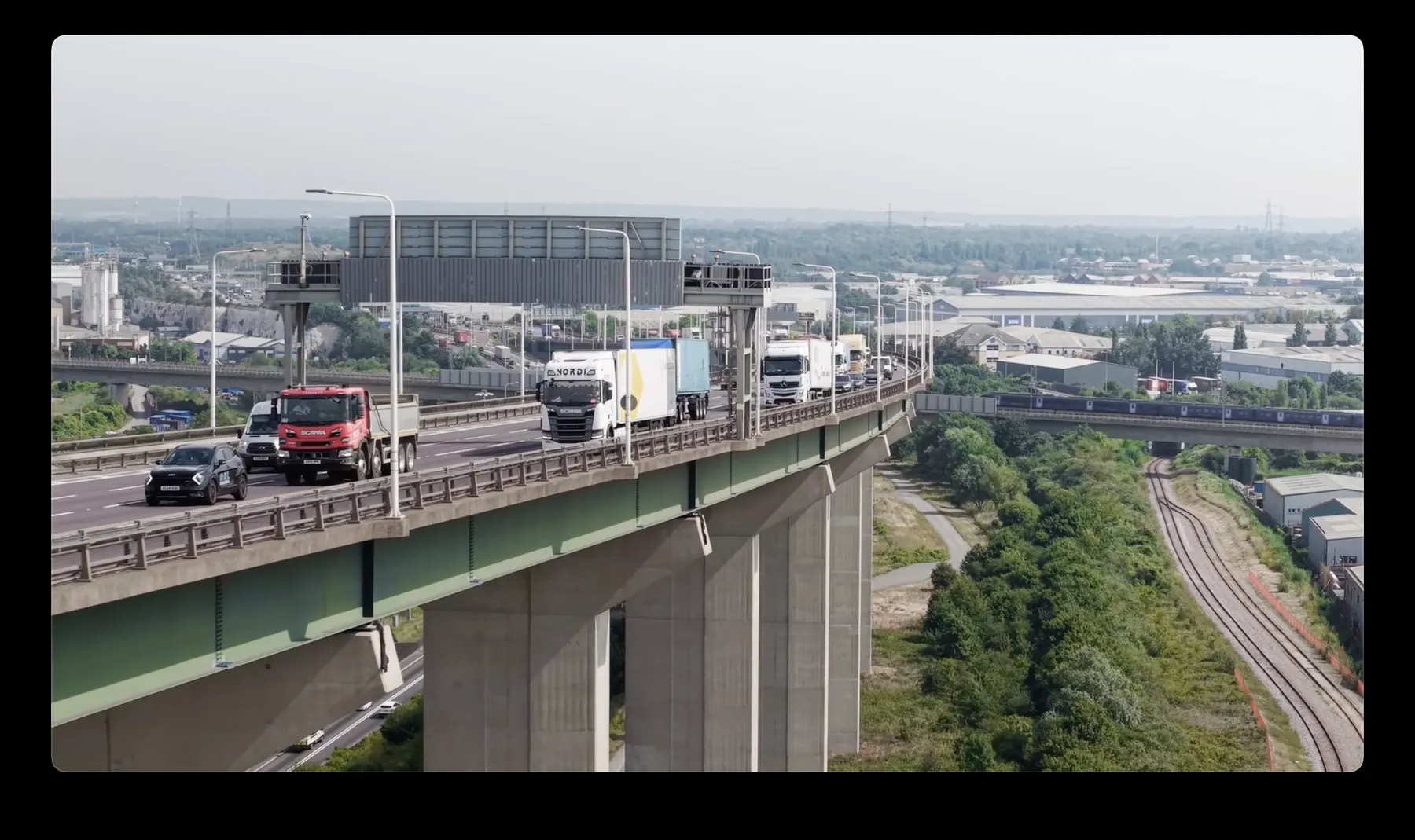
Nordi is a Ukrainian transport and logistics company running cargo across Europe and Asia: forwarding, customs brokerage, intra-European transport and consolidation through European warehouses. They contracted us to document their UK operations from the air.
The brief is one we see repeatedly, and it comes with a problem attached. Logistics companies do genuinely impressive things at enormous scale, and then illustrate them with a photograph of a tractor unit parked on a hardstanding.
Why the parked lorry photograph fails
Because it communicates nothing that matters. Every competitor has the same vehicle, the same livery position and the same car park. The photograph says the company owns a truck.
What a logistics buyer is actually assessing is capability: how much you can move, how far, how reliably, and how well organised you are. None of those are visible in a static shot.
Movement and scale are visible from the air, and almost nowhere else.
The three shots that carry a logistics film
The tracking shot. The camera moving with a vehicle at road speed, at a height and angle that keeps both the vehicle and the road ahead in frame. This is the shot that conveys distance and momentum, and it is the backbone of any transport film. Done properly it is also the hardest, because it requires the aircraft to match a moving subject smoothly over a long enough run to be usable.
The reveal. Starting tight on a detail, a trailer door, a curtain side, a wheel, a driver, then climbing and widening to show the yard, the fleet or the motorway. This is the shot that converts one vehicle into an operation, and it is the single most effective way to communicate scale in eight seconds.
The overhead. Directly above a yard, a distribution centre or a loading operation. This is the shot that shows organisation: how many bays, how many vehicles, how the flow works. Operations directors love it because it is the only image that resembles how they think about their own site.
Everything else in a logistics film is connective tissue.
The practical constraints nobody mentions
Roads are full of uninvolved people. Filming a vehicle on a live public road means everybody else on that road is uninvolved, and the rules about distance apply to all of them. In practice this means a great deal of transport tracking is done on private roads, on site, or on quiet stretches chosen and assessed in advance, rather than on a motorway.
Yards are busy and moving. A distribution yard is a working environment with vehicles reversing and people on foot. Aerial work there needs a briefed exclusion area and a site contact, not just permission to be there.
Weather kills schedules. Vehicles run in all conditions and aircraft do not. Building a shoot day around a fleet movement that has to happen anyway, with an agreed fallback date, is how this stays affordable.
Do it once, use it for years
The advantage of fleet and logistics material over most commercial content is that it dates slowly. Vehicles, yards and roads look much the same in five years. A single well-planned day produces a library that covers a website, a tender pack, recruitment, social, and trade press for a long time.
That is a better proposition than most marketing spend, and it is why we push clients towards a proper library rather than a one-off hero film.
The Nordi project, including the cut sequence, is on the Nordi project page.
For commissioned commercial work, see drone filming in London, construction drone filming, or get in touch.